R. Daneel Olivaw
The Caves of SteelR. Daneel Olivaw is a Spacer robot built to look and behave more like a human than the machines familiar to Earth. His assignment as Elijah Baley’s partner brings that deliberate resemblance into the center of the investigation into Dr. Sarton’s murder: Daneel is at once a detective, a witness whose legal standing is uncertain, and a creation whose original purpose extends beyond the case. His progression from experimental observer of human psychology to investigator embodies the novel’s unresolved tension between machine design and human social life.
Identity and Design
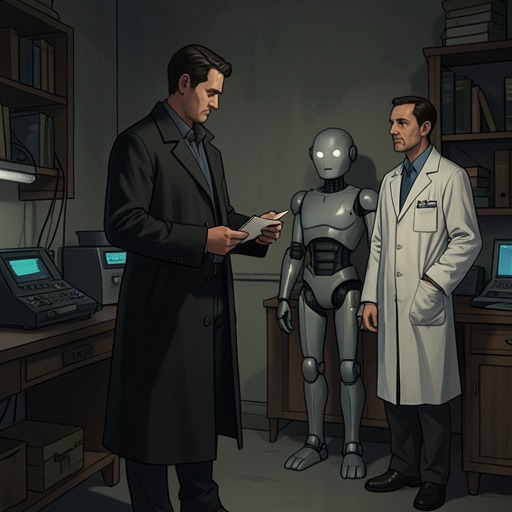
Daneel introduces himself to Baley by his full name, then states plainly that he is a robot. Baley, who had been told to expect a partner but not adequately prepared for this encounter, recovers from his surprise, identifies himself, and offers his hand. Daneel accepts it with a controlled, friendly handshake and asks Baley to speak frankly, explaining that partners on his world customarily use familiar names. Their first exchange establishes both the perceptual shock of Daneel’s human likeness and his conscious effort to make a working relationship possible.
Daneel is not representative of every Spacer robot. He explains that a robot’s outward appearance depends on its function, and that other robots are humanoid but less closely modeled on people. His own appearance is especially human because his intended work requires him to enter human society and observe it at close range. Dr. Sarton had spent a year developing this design; Daneel was the first such robot and, at that point, the only one. The murder has forced him into his role before his education is complete.
That incomplete preparation complicates his appointment as an investigator. Baley learns that Daneel’s circuits have received a final adjustment: a particularly strong desire for justice has been inserted into his motivation banks. The adjustment equips him for detective work without making that work his original purpose. Baley reacts to the word justice with distrust, and the moment leaves open a distinction the case repeatedly tests: Daneel’s investigative drive has been designed, but the capacities and identity it redirects are not reducible to the new assignment.
From Human Observer to Investigator
Daneel’s original design was to study human psychology for the people of Spacetown. He later explains that his construction was for cerebroanalysis: interpreting brain waves through field measurements, without direct electrode contact. His own mind can serve as the receiver when the proper equipment is available. The detective role, then, is a premature turn in the career of a machine designed to read human minds and behavior.
The murder is the immediate cause of that change. With Dr. Sarton dead, Daneel is hurried into the investigation before his education has been completed. His humanlike body is not a disguise added for the case but part of the earlier research project: it was meant to help Earthmen accept him and allow him closer access to their lives. The investigation therefore places him in the unusual position of pursuing a crime that has disrupted the very work for which he was created.
The assignment unfolds within a politically divided jurisdiction. New York City is responsible for events inside its limits, including Spacetown, while the Spacers retain extraterritorial rights and can insist on their own investigation. The Commissioner fears that the Outer Worlds could use the murder to demand indemnities, creating pressure on both Earth authorities and the Spacers to control the investigation’s outcome. Daneel’s work with Baley thus takes place within overlapping legal and political claims, not simply a local police inquiry.
Partnership, Evidence, and Legal Status
Daneel approaches partnership as a relationship that depends on frank exchange. When he first meets Baley, he asks for openness and invites the familiar mode of address customary on his world. Later, underground in New York City, he warns that they may be overheard; when Baley dismisses the concern, Daneel returns to the investigation and points out that the Commissioner, as a City dweller present at the scene, was inevitably a suspect. His interventions combine caution about their circumstances with methodical attention to the case.
His value as a witness is inseparable from his status as a robot. Baley objects that no Earth court would accept a robot’s account as credible testimony once its source was disclosed: robots, he says, have no standing in an Earth court of law. That exclusion creates a sharp contradiction. Daneel can possess a capacity relevant to the investigation—such as remembering faces despite a blur of many people—yet the legal system may refuse to recognize the person or machine supplying that evidence. His unusual powers do not automatically translate into civic authority.
The distinction between what can be known and what can be proved shapes the partnership. Baley insists that Daneel’s ability to identify faces would not persuade a court, and emphasizes that disclosing his robotic identity would disqualify him as a witness. The case therefore puts Daneel’s investigative usefulness beside the limits imposed on him by Earth’s legal institutions. He can assist in reaching an account of events while remaining unable, on Baley’s understanding, to validate that account in court himself.
Identity, Conflict, and the Case’s Resolution
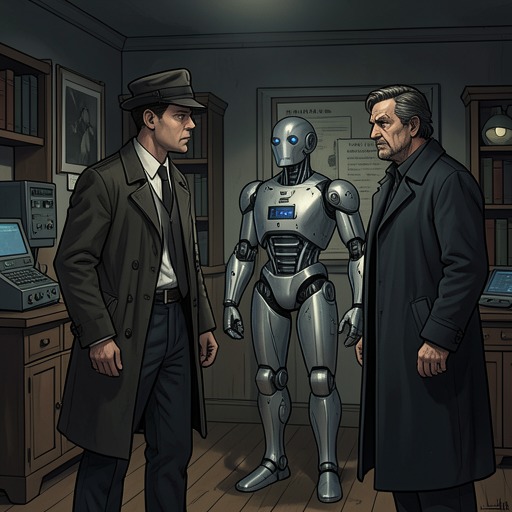
The investigation exposes how Daneel’s resemblance to a human can be exploited as well as misunderstood. Baley argues that the apparent murder of Dr. Sarton involved a robot made to look like Sarton, whose remains were shown to the Commissioner. Dr. Fastolfe counters that this explanation requires R. Daneel to have impersonated Sarton and Dr. Sarton to have impersonated Daneel; he argues instead that Daneel is a robot and the body was Sarton’s. Baley challenges the weight of the Commissioner’s observation, pointing out that the Commissioner was not a robotics expert and could not rule out the existence of more than one such robot. In this dispute, Daneel’s likeness is central to competing explanations of who was present and whose identity the evidence supports.
Daneel’s designed purpose also outlasts the detective work. When he explains that cerebroanalysis remains his essential function, the earlier justice drive appears as an imposed adjustment rather than a replacement of his original design. The novel connects his ability to investigate human conduct with his intended ability to study human minds, while keeping their relationship distinct: one is a special motive installed for a crisis, the other the fundamental purpose for which he was made.
Near the end of the case, Daneel tells Baley that the Spacers will end the investigation into Dr. Sarton’s murder that day and begin planning to leave Spacetown and Earth. The decision follows information Daneel has supplied to his people. Baley, meanwhile, must clear himself of suspicion in the destruction of K. Sammy by means other than continuing the inquiry into Daneel’s designer. The murder investigation’s closure is therefore also a limit on Daneel’s immediate role: his report helps determine the Spacers’ departure, but it does not resolve Baley’s separate predicament.
Narrative Significance
Daneel makes the category of the human difficult to treat as self-evident. His body has been designed to invite acceptance by Earthmen, while his identity as a robot places him outside the standing Earth’s courts grant to human witnesses. The contrast is not merely between appearance and hidden machinery: the narrative gives him a defined investigative motive, a capacity for close partnership, and a vocation for analyzing human psychology, while also making clear that these features arise within a constructed being whose design is still developing.
His two purposes—the original work of cerebroanalysis and the hurried, justice-driven investigation—also give his role a productive tension. He is made to observe humans from within their social world, and then enlisted to solve a murder that has unsettled the relations between Earth and the Outer Worlds. By making a robot both the investigator’s partner and a potentially inadmissible witness, the story shows that knowledge and authority are not the same: Daneel may help uncover the truth without being granted the institutional status to testify to it.